Wednesday, November 20, 2013

Be a good tourist and get drinking!

The past week I've been attending an advanced course on sustainable tourism in the Cinque Terre, which is being held on top of the hill in Vernazza, run through Vivilitalia and the Alta Scuola Turismo Ambience.  It's an intense, heavy course full of information with some more information scattered on top for good measure, so my brain is normally throbbing in Italian by about 3 pm.  Despite the headache of intense Italian, it's been incredibly interesting.
Rainbow over the hills of Vernazza

We live in a national park and a UNESCO world heritage site, and an incredibly fragile one at that.  As one of our guest speakers noted, the Cinque Terre is one of the few national parks that relies on man to keep it alive.  Whereas other parks are simply nature, untouched, at its pure finest, the Cinque Terre relies on the terracing systems of the vineyards that stretch on the hills between the villages.  Manmakes these terraces, so it's a very delicate, very beautiful, and very important balance between man working with nature rather than against it.
View over Vernazza from the vineyards of Cheo

One of the main points we've discussed is the importance of sourcing products at "kilometer 0", or, in other words, eating local.  As local as you can get.  All of this eating local is integral to creating and promoting sustainable and responsible tourism, but you need to wash it down with something.  
One cannot come here and avoid wine.  Even if it's not in a glass in front of you, it's neatly covering the hills sloping down into the villages, in even little rows held up by ancient stone walls.  These wine terraces, they say, if put back to back, are as long as the Great Wall of China.  That's pretty long.  And they don't make wine on the Great Wall, so I'd say we win.
Mr. Cheo himself giving us a talk on their wines

Without going into too much wine detail, as I'm not a sommelier and don't pretend to be, the wine here is mostly white, and has to be a blend of grapes including Bosco, Vermentino and Albarola.  It's on the drier side, and was never, in all honesty, to my taste until this year.  Manuel's mom explained once that you can certainly find more prestigious white wines in Italy, more award winners, but you will never find a wine that is made with these centuries of hard, back breaking work carrying the grapes up and down these terraces mountains that loom over us.  There is a great story and a great determination in these wines and the Ligurians who have been making them for centuries.  
Looking over the dry stone wall terraces that lace the region


After pondering this, the next glass I drank took on a new meaning.  Even more so when I realized that the land depends on these terraces to keep it stable.  The great majority of villagers are no longer relying on farming and fishing to make a living, the many small, usually family run wine producers in the region are doing more then providing us with something to drink- they are helping keep that delicate, crucial balance between man and nature.
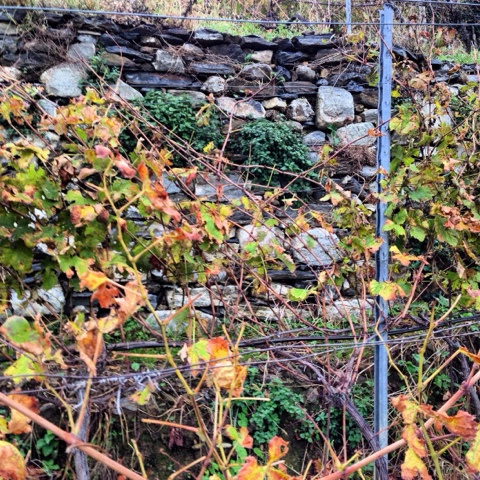
One of the many walls up close

Today we hiked up small, slippery stone steps to the vineyards of Cheo, a small producer in Vernazza that was all but destroyed in the flood.  The husband and wife team were able to rebuild, with help from other wine producers in the region who came right over and helped them the laborious work of reconstructing the dry stone walls that create the terraces that compose the vineyards on the mountains.  They are incredibly lovely people, which is even nicer to know, as their wine is one of my favorites in the Cinque Terre.  The grapes that grow in the summer sun over the Ligurian sea, with the colorful little village of Vernazza spread out before them, make a beautiful picture.  Descending the narrow steps back to the village, however, you are again reminded that what makes a surreal postcard is also an incredibly labor intensive work.
The vines

Tourists visiting the region can do their part quite easily.  Drink up!  The majority of the wines here are small producers, and it's critical to the sustainability of the region that their production continues (here in Monterosso, Vetua and Begasti are my favorites, outside, Cheo from Vernazza, La Polenza and Forlini Cappellini are other great ones...).  Little did you know that drinking some local wines, watching the colors of orange and pink, as the sun kisses the still blue sea, you were perfectly doing your 
part to help ensure the future of our amazing National Park.

Salute! 
Not a bad view from the "office" of Cheo


Saturday, November 2, 2013

I am mad at Venice.

It's so touristy.

It's a dying city built on dirty water.  It's full of people trying to rip you off.  It's too crowded.  It's like a theme park.

You can't eat a good, authentic meal without paying as much as your monthly salary.  You can't find a decent place to stay that doesn't cost as much as your monthly rent.  It's hard to get around.  The locals are really mean and hate tourists.  It's just not worth all the hassle.

Gondola parking by San Marco
The little island of Burano, about 45 minutes in vaporetto from "main" Venice


A Venetian water bus view at rush hour.  Not a bad for for a commute.


But I'm mad at Venice because I never went sooner.


I'm absolutely in love.

Rialto Bridge at sunset
I heard all of the above reasons for avoiding Venice for most of my life.  Before moving to Italy, I came here on vacation seven or so times, and somehow managed to always keep Venice out of my travel plans.  Put off by accommodation prices and a little intimidated about people's lamentations of bad restaurants, it just did not sound like it was for me.  I live in one of the more touristy parts of this country, and have a high tolerance for that sort of mess, but was very apprehensive about throwing myself into that same mess along with them.

We booked a few days in Venice and as soon as we stepped out of the station, I cried a little (this is not weird, I am one of those people that cries at especially touching phone commercials and sunsets).  I was just floored to see a street made of water, a metro stop of boats not busses.

We got on our little vaporetto, and my ear to ear grin did not stop until we left this incredibly magical city.   La Serenissima (one of Venice's many nicknames, meaning "the most serene") is it's a city built not on the water, but actually IN it, on about 118 small islands.  You see locals hopping in a traghetto to cross the canal without holding onto anything for balance, and can't help thinking that these people are of the water, not of the land.  Like the city they live in, they balance on the water.  They live in it.

Vacations are different for everyone, and logically everyone has different experiences, but we had a perfect few days of 22 degree sunny weather (low 70's F), no cruise ships, no big tour groups, and a city slowing down off the summer season.  Of course there were other tourists, and getting a sunset picture at the Rialto Bridge was a bit of a nightmare, but it didn't dampen any of the wonder I felt wandering around such a strange, unique and beautiful city.

Typical cicchetti at a bar by Santa Marina
We took a boat to Burano, full of colorful houses and fishermen perched on little canals, and explored the glass making island of Murano.  We drank spritz cocktails at sunset sitting along the canal.  We inhaled plates of sarde in saor (a sweet and sour agrodolce dish of sardines cooked in sugar and onions and pine nuts served over polenta) and munched on lightly fried local soft shell crabs, called moeche.  My favorite part of the eating is going into a little osteria or bacaro (venetian for a sort of bar that serves cicchetti, or tapas snacks and small plates), grabbing a glass of local wine that costs a few euros, and asking for a few snacks - the cicchetti can cost a few euros each, but many places will make you a mixed plate for a fixed amount.  You can see the selection on chalkboards or in the glass cases by the bar.  The price only applies for standing up and eating at the bar, along with the Venetian men on their way home from work who stopped in to down a glass of wine and have a quick nibble or two.
Mixed cicchetti plate for 2 at Osteria Bancogiro - cost 15 euro for 20 pieces

The people we interacted with, with their heavily cadenced Italian and totally incomprehensible local dialect, were really fantastic.  I found everyone to be friendly and helpful, explaining water bus lines, recommending wines, and even explaining some of the local plates to us at the bar.  I saw a tiny old lady crossing one of Venices 456,567 little bridges with difficulty, but then stopping to let some little blonde swedish babies pass her, all the while gently chiding, "be careful you beautiful children, it can be a little slippery" with a big smile on their face.  Their blue eyes looked solemn as they seemed to absorb the message, understanding nothing of the older woman's Italian.  She stopped, saying to herself, "how beautiful those children are", and smiling, pausing at the start of the steps of the bridge.  I wanted to hug her.

The view from our room at Ca'Amadi.  Note the elderly woman hanging out her laundry.  You drop a sock here, you are done kids.  Canal sock must be a common happening for novices.
I can see how there is the potential for Venice to be too much, but that can be the case in most cities (and small villages on the Ligurian coast, for example) during high season for a day tripper or a cruise ship tourist. We were lucky to have the experience that we did, but that is part of the reason you need to come to Venice.  Regardless of all of the mixed opinions of it, it's something that you need to decide for yourself.  Love it or hate it, Venice is a place that the word beautiful does not do justice.  It's bewitching, magical and unique, getting lost in a small alleyway that empties out to a lagoon lapping at your feet.  And you have to decide for yourself which spell this enchanting city of bridges and canals casts.


Notes about our trip:
Branzino with pancetta and spinach at L'Osteria di Santa Marina
We stayed at Ca'Amadi, a great little b&b a few steps from the Rialto Bridge.  Once the house of Marco Polo, the suite we had was large and airy, and had two windows opening onto a small canal, which was surprisingly quiet at night.  We also got a fantastic rate last minute, mid-week in late October/early November.


I had the best meal I have had in a very long time at L'osteria di Santa Marina.  It is a refined place that serves incredibly well prepared plates and left us speechless.  I don't know how they do not have a Michelin star.


I also inhaled the best branzino (sea bass) of my life in Burano, at Rivarosa Ristorante.  Sitting along a little canal on this perfect little island with it's rainbow of houses, eating such a succulent piece of fish in the sun is a memory I will have for a long time.
Sarde in Saor at Vini da Gigio

Local branzino steamed with local roasted artichokes and a great chardonnay at Rivarosa, in the island of Burano
Vini di Gigio is a great place for a nice, simple meal of local plates (sarde in saor, moeche, and even the land dishes of the region, like a small hen stuffed with livers and salame then roasted) with a great wine list.


We loved the cicchetti at Cantina Do Mori, an ancient wine bar not far from the Mercato full of local old men knocking back wines and snacking alongside of us.

We also loved Osteria Sacro e Profano, Osteria Bancogiro, Osteria All'Alba and La Cantina...I didn't think it was possible to find a population of people that drink more then the Monterossini, but I did.  A spritz at 10:30 am is not at all strange in Veneto.

Definitely, 100% bring a smartphone or tablet with GPS.  You will get lost.  Many times.  After a few hours, I resigned myself to the fact that when I decided to go right, it would most certainly be wrong, and I would have to turn around at least 4 times.  Plan on an extra 15-20 minutes to arrive somewhere you haven't been before - at night it all looks the same, and you will literally wind up at a canal in the dark more then once.

Bring a charger or extra battery for your camera or phone.  You will take an amount of pictures of this incredible place that borders on obscene.  Then you too will start a blog solely to show them off to your friends and family.

Be patient, smile, and remember that you are walking in one of the most incredible cities that man has ever built.  Not something you do every day.

Enjoy!


Wednesday, October 16, 2013

Just a few more reasons to love October...

Cabbage season is upon us...hello, kim chi

And romanian cabbage soup with dill dumplings...

The temperature has dropped just enough to turn the oven on and not roast myself along with my desserts...
Maple syrup, apple and bourbon bread pudding with sea salt caramel sauce

Butterscotch pudding
Espresso chocolate cupcakes with mocha buttercream


I have the following things all to my happy self...
My favorite reading rock by the Gigante


My favorite table at Pie' Du Ma in Riomaggiore

My sunset at my favorite table with no one jockeying for the best position to photograph it


My favorite rock.  And no one else around it.

Vernazza.

Sharing the sea with a few pirates.

The long stretch of beach free of umbrellas...the private beaches have closed for the season

This view...

...and this one.

I suppose I should be touting the joys of being here in October - taking the risk of a few rainy days but having these amazing views and clear but chilly blue sea to yourself is worth it.
But in all honesty, I quite like having it all to myself for a few beautiful days a year.  So, stay home.
(Joke)
October is wonderful.  Aside from the fact that you do run the risk of hitting some rainy, miserable days, the clear ones really make you just walk out of your house, look at the sea, and smile.  

Sunday, September 29, 2013

From grapes to grain...

When people think of "La Cantina", they think of wine.  We're in Italy.  We drink wine.  It makes sense.  Long dinners swirling ruby reds, chilled whites, terrace covered hillsides and Tuscan rolling countryside dotted with vineyards like pinpricks on a map.  It's hard not to think about another beverage so important to Italian culture, except for maybe coffee, and that makes more of a pitstop in your day as opposed to a long appearance at your table.
Some of our beers at the Cantina
Beer, however, has been making a lot of noise in the last decade in Italy.  No longer regulated to it's prize post as the beverage of choice of Italians while eating pizza (wine, no, but beer is a pizza must), the craft beer movement in Italy has been growing steadily in the past several years.
When I met Manuel before moving here, I was actually here to study this trend for my MA in Food Studies at NYU.  Traveling around the country, I tasted many different Italian craft beers from Udine to Reggio Calabria (it's a tough life sometimes), and interviewed many Italians and tourists about the craft beer scene in Italy.  Back to New York in 2010, using the about to open Eataly brewpub as an example, I studied the export influence of Italian craft beer.
Beer and cheese, my preference over beer and wine
A tripel and a basil blonde, both from Genova
I learned that as excited as Italians are about birra artigianale, craft beers from the boot are not as well known in the United States for a variety of reasons, price, bottle sizes (many Italian beers are made in the 75cL wine bottle size, not the smaller bottles you might be more used to seeing) and domestic competition being big ones.  This is cemented even more working in La Cantina Di Miky, where we now have one of the biggest Italian craft beer selections in this part of Italy.  Through a lot of research and hard work (again, life can be tough) we put together a list of 62 different bottled microbrews and 4 on tap.  We offer a flight of beer tastings with Ligurian snacks to try and encourage people to branch out and try some craft beers.  I'm incredibly proud of our beer list and how many people have come back just to try the beers.  Ranging from a local summer ale from La Spezia, to a basil beer from Genova to a Tuscan roasted chestnut beer and a Roman pilsner, we have a huge selection, and every day I see more and more guests shocked and happily surprised at it.
Having worked at a brewpub in New Jersey for more then a decade and in the beer industry for my entire adult life, I learned early on to appreciate craft beer.  I love wine, but my heart belongs to another.  I also learned that not everyone wants to give it a chance (my Italian grandfather, for example, was a staunch Coors light drinker in spite of my best efforts to sway him) and that when people come in and order "a beer", you have a great opportunity to introduce them to something new.
On tap at Il Bovaro in Florence
Though here in Italy, Italians are becoming more and more aware and proud of their craft beer movement, many foreigners aren't as aware that they have another completely Italian drink option when on vacation.  As much as people associate wine with Italy, beer is just as great of an example of taking the Italian food philosophy and applying it to something.  Take what is local, take what you have, and get brewing - hence roasted chestnuts, basil, sardinian wildflower honey, sicilian orange peel, and so forth.  Like the United States 20 years ago, the lack of a brewing tradition like a Bavarian Purity Law or some Belgian monks breathing down your neck, means that Italian brewers can take inspiration and styles from all around the world and play with them in their own way, though they certainly love their Indian and American Pale Ales.
For those of you coming to Italy, it's really worth it to branch out.  Take the words Peroni and Moretti temporarily out of your vernacular and ask for something local, something unique, and drink up.


Beers with my cousin Valentina in Cividale (Friuli)

Thursday, September 12, 2013

ciao from corniglia

Corniglia...


...however unjustly, is probably the most underrated of the Cinque Terre.

People here for a day or two (which seems to be the norm) are trying to maximize their time, and the allure of the village perched on the rocks doesn't outweigh the 387 steps you need to climb to arrive in the village.  The boat doesn't stop here, a car is more or less useless in exploring the region, and the train connections to here aren't as frequent as bigger Monterosso or Riomaggiore.  The village does offer a small blue bus to bring visitors up from the station to the center of town at a fee (a well spent 2 euro), and though theoretically it should arrive in concurrence with the trains, the world isn't perfect, and Italian train and shuttle timings are far from that.

Once you arrive in the village, a shy beauty perched atop a cliff, she opens her arms to you.  Streets isn't the correct word. Corniglia is full of alleyways that wind up to more stone steps, down to wind battered gates perched over the sea, and open into a windy piazzetta, a terrace with a stunning view, or a tiny church looking protectively down on it's few residents.  The stairs do not end when you arrive in the village center, as the stone houses built into the rock sprout other houses atop them, other little offshoots that pile on top f each other in a seemingly impossible balance of color.  Corniglia is the tiniest of the villages, and offers the least in terms of dining options or bars, but oozes and romantic and eerie sort of charm.  Time here isn't spent in terms of days, as the village is so small that a few quick passes here and there can cover the whole thing, but a few left turns instead of rights can bring you to quiet stone terraces with breezy, 360-degree views.  Ducking through an arch and looking to the left, another open balcony is covered with nets, as local boys practice their soccer, ingenious in their method to make sure the ball doesn't fall hundreds of feet into the crashing blue sea below.


The other villages have had a healthy rivalry through the centuries, and locals are very proud of their homes.  Those from Monterosso might scoff at Riomaggiore, those from Vernazza thumb their nose at Manarola, residents of Riomaggiore laugh at everyone else, and so forth, but Corniglia, as has been mentioned "never bothered anyone".

You feel that sort of beautiful isolation twofold here, already within an area of villages already difficult to reach, to add the challenges of Corniglia on top of that seems almost impossible.


Though Corniglia might be the most overlooked, like a beautiful and timid girl in the back of the room, she looks up at you and smiles knowingly.  Corniglia doesn't care.  She's perfectly secure in knowing that she's the real star of the show, and happy to share her secret with the few who want to seek her out.

Friday, August 30, 2013

arrivederci agosto

Other things besides work that happened in the crazy month of August...
My cilantro and dill seeds sprouted and thrived

I found my dream house (tower?) for sale in Sestri Levante

Sunsets and sailboats

Monterosso in the August sun

The hills above the village, between Levanto and Monterosso

Blueberry muffins with local blueberries from our friendly farmer

Pebbles and the clear blue sea

Birds at sunset in Levanto as the shadows of the other part of Liguria and France hover on the horizon

A lightening storm lights up the night sky in Monterosso